Disclosure: Some links on this page are affiliate links. If you buy through them, we may earn a commission at no extra cost to you. We only recommend products we believe may help picky dogs. As an Amazon Associate, NoPickyDog earns from qualifying purchases.
Quick answer
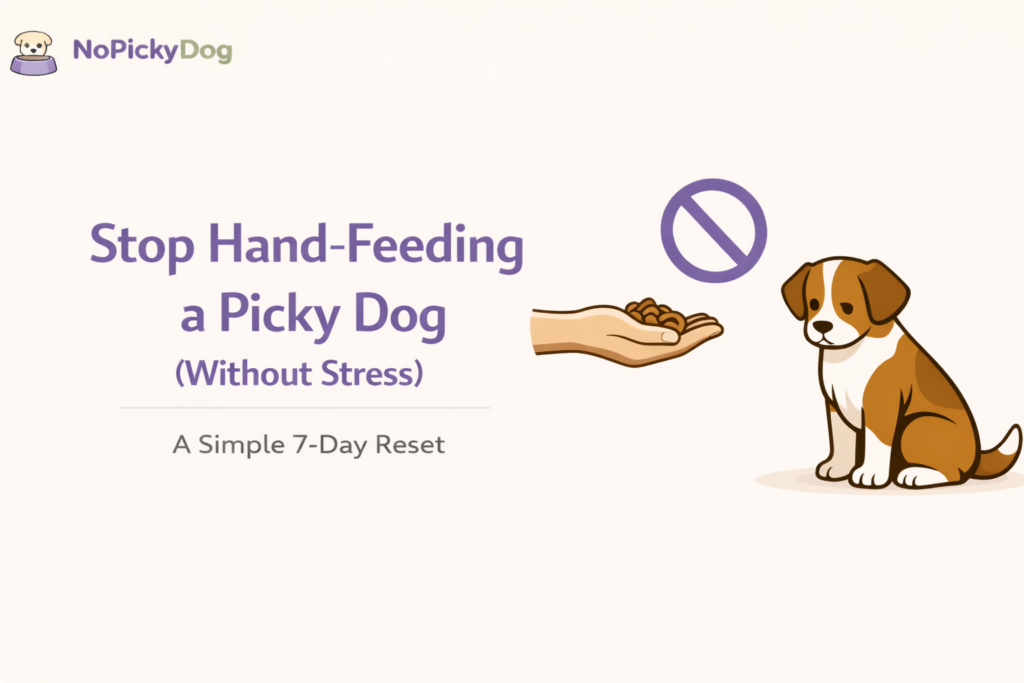
If your dog only eats when you hand-feed, you’re not dealing with “stubbornness.” You’re dealing with a pattern your dog has learned: food shows up only when you negotiate. The fix is not more toppings. The fix is a short reset with clear rules, calm repetition, and zero pressure.
This guide shows you exactly how to stop hand-feeding safely, what to do when your dog refuses a meal, and when to call a vet.
Before you start: safety check (don’t skip)
Stop and contact a vet quickly if you see any of these:
- Vomiting, diarrhea, bloody stool
- Sudden appetite loss (especially if usually food-motivated)
- Lethargy, dehydration, pain, fever
- Weight loss, very young puppy, senior dog, or chronic disease history
If none of those apply, you can do the 7-day reset below.
Why hand-feeding becomes a problem
Hand-feeding is not “bad.” It’s often useful short-term: after surgery, during anxiety events, or when rebuilding trust.
Hand-feeding often becomes part of an “upgrade loop.” This explains the mechanism (and how to break it):
Why Dogs Get Picky: The “Upgrade Loop” (How Treats & Toppers Teach Refusal)
The problem starts when hand-feeding becomes the only way your dog eats. Then the dog learns:
- “If I wait, a better option appears.”
- “If I refuse, the human escalates attention and offers upgrades.”
- “Eating is part of a negotiation.”
This is one of the most common picky-eating loops. If you want the bigger picture of why picky behavior starts, read: Why Dogs Get Picky
The rule that makes this work
Meals are offered on a schedule. The dog chooses to eat or not. The bowl is removed calmly. No upgrades. No chasing.
That’s it. This rule is what breaks the “hold out for better” pattern.
If you want the full 7-day picky-eating reset framework, start here (this post fits inside it):How to Fix a Picky Eater Dog Fast: A 7-Day Plan That Works
The 7-day plan to stop hand-feeding (step by step)
Day 1–2: end the negotiation gently
- Pick two meal times and stick to them (example: 8am and 6pm).
- Put food down for 10–15 minutes.
- If your dog does not eat, pick it up. No emotion. No talking.
- Nothing else until the next meal time except water.
Important: Don’t “test” with treats all day. Treats are what keeps the negotiation alive.
Day 3–4: rebuild confidence without your hand
If your dog hesitates but wants to eat, your job is to reduce pressure:
- Put the bowl down and step back.
- Turn slightly sideways. Look away.
- Use a calm routine phrase like “Dinner time.”
- If they approach, do nothing. Let them choose.
If your dog paces, stares at you, or “asks” to be fed by hand, do not respond. You’re not ignoring your dog. You’re ending the training loop.
Day 5–7: add structure if needed
If your dog still refuses more than one meal, add one of these structure boosters:
Option A: slow feeder
Some dogs refuse food because they eat fast, then feel uncomfortable or nauseous. A slow feeder makes meals calmer.
Option B: scatter feeding
Measure the meal, then scatter it on a clean mat or tray. This removes the “bowl pressure” without using your hand.
Option C: short pre-meal walk (5–10 min)
Light movement can increase appetite without adding “special” food.
What to do if your dog skips meals
Healthy adult dogs often skip a meal or two during a reset. The key is consistency.
Use this decision rule:
- Skips 1 meal: normal in a reset. Continue.
- Skips 2 meals: continue but tighten rules (no extras).
- Skips 3 meals or shows any red flags: call a vet.
Do not “panic feed.” Panic feeding teaches the exact behavior you’re trying to stop.
If you’re adding toppers or fresh food
Toppers are fine if they are planned, not used as a response to refusal.
If you’re using fresh foods, portions and safety matter. Use this page to avoid common mistakes:Dog Food & Safety Guides
Recommended tools (optional, but helpful)
Affiliate note: If you buy through these links, we may earn a commission at no extra cost to you.
1) Treat pouch (removes hand-feeding habits during training)
What to look for: easy open/close, washable liner, clip that doesn’t slip.
- Best overall: [Treat pouch (Amazon)]
- Budget pick: [Budget treat pouch (Amazon)]
How to use in this plan: use it for training rewards only, not meal replacement. Reward calm behavior away from the bowl.
2) Lick mat (for anxiety-driven picky eating)
What to look for: food-grade silicone, suction cups, easy cleaning.
- Best overall: [Lick mat (Amazon)]
- Budget pick: [Budget lick mat (Amazon)]
How to use in this plan: only if anxiety is the issue. Use outside meal times as a calm-down tool, not as a “refusal reward.”
Common mistakes that keep the problem alive
- Switching foods during the reset
- Hand-feeding “just this one time”
- Adding treats because you feel guilty
- Leaving food down all day (grazing)
- Begging, coaxing, talking, or hovering over the bowl
Your dog is not trying to win. Your dog is repeating what has worked before.
FAQ
Will my dog starve if I stop hand-feeding?
Healthy adult dogs do not starve from skipping a meal or two. The risk is not “starving.” The risk is you teaching the dog that refusal creates upgrades. If your dog is a puppy, senior, underweight, or has health conditions, call a vet before doing a reset.
Should I change dog food if my dog is picky?
Not during the reset. First fix the routine. After the routine is stable, then evaluate whether the food is a poor fit.
What if my dog only eats when I sit next to the bowl?
Start by sitting farther away each meal. Two steps back. Then across the room. The goal is to remove your presence as the trigger.
How long does it take to stop hand-feeding?
Most dogs improve within 3–7 days if you stop negotiating. Some anxious dogs take longer and need calmer routines.
Next steps
Pick the path that matches your situation:
- Run the full picky-eating reset (7 days):
How to Make a Picky Dog Eat (Fast): A 7-Day Reset Plan - If treats are replacing meals (use the treat budget rule):
Treats vs Meals: The 10% Rule (Stop Treats From Replacing Dinner) - Fix portions/treat calories (most common hidden cause):
Portion Basics: How Much to Feed a Picky Dog (Without Guessing) - If mornings are consistently the worst:
Dog Not Eating in the Morning? 9 Common Causes + What to Do - If you’re worried it might be medical:
Dog Not Eating But Acting Normal? 11 Common Causes + What to Do - Understand the common causes behind picky behavior:
Why Dogs Get Picky - Food & safety (before changing foods or adding extras):
Food & Safety Guides
Medical disclaimer: This content is for informational purposes only and does not replace professional veterinary advice.