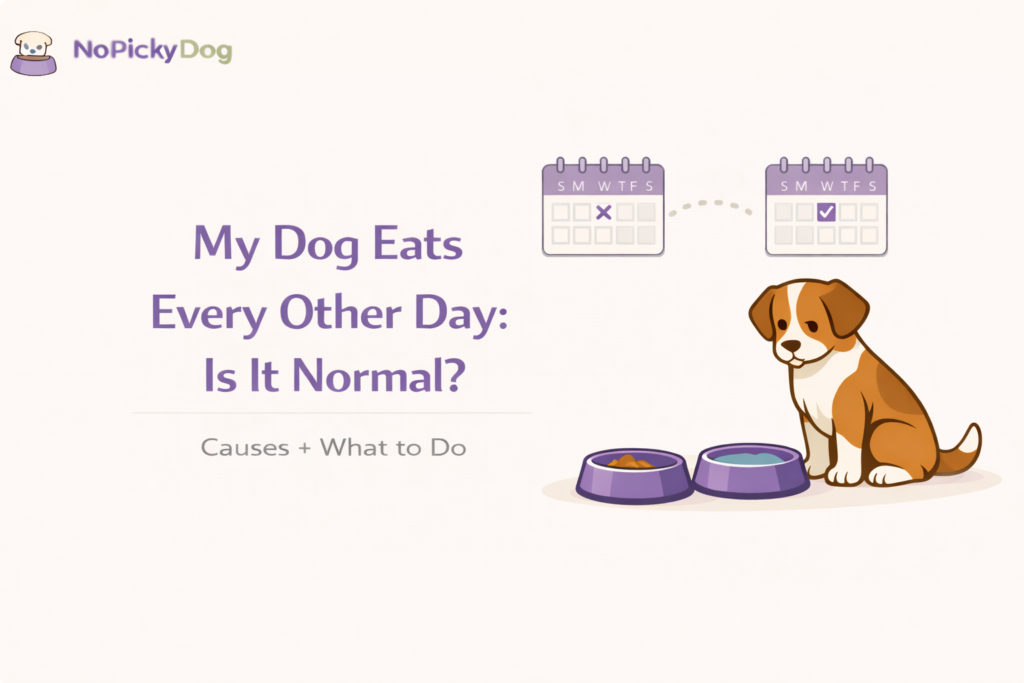
If your dog eats every other day, it can feel confusing—especially if they still have energy and seem “fine.” Some adult dogs do okay with fewer meals, but a sudden change in appetite is never something to ignore. The goal is not to force food with better treats. The goal is to (1) rule out red flags, then (2) restore a calm, consistent meal rhythm so you can tell whether this is routine/behavior or something medical.
Quick answer
A dog that eats every other day usually falls into one of these buckets:
- Not truly hungry (overfeeding, too many treats/chews, low activity, or a very calorie-dense dinner)
- Mild nausea or stomach discomfort (they’ll eat “sometimes,” but skip full meals—often worse in the morning)
- Mouth pain (dental disease, sore gums, or chewing discomfort that makes eating unpleasant)
- Learned picky behavior (skipping meals leads to “upgrades” like toppers, new foods, or hand-feeding)
If your dog eats every other day but is otherwise acting normal, start by treating this as a routine + calories problem: tighten the meal schedule, remove treats between meals, and stop “upgrades” for skipped meals.
If your dog is a puppy, senior, very small breed, has diabetes, has repeated vomiting/diarrhea, won’t drink water, seems painful, or is losing weight, don’t treat this as “normal.” Start with the red-flag checklist below and contact your vet.
If your dog is skipping full days of meals and you’re not sure what’s safe today, use: How Long Can Dogs Go Without Food? Safe Limits + What to Do Today
Step 1 — Check red flags first (do this before any “training” plan)
If any of these are true, book a vet visit first—don’t try to outsmart appetite.
Same-day vet / urgent signs
- Repeated vomiting, or vomiting + weakness
- Bloated belly, retching, obvious abdominal pain
- Collapse, pale gums, trouble breathing
- Refusing water or showing dehydration signs (dry gums, very sticky saliva)
- Possible toxin exposure
Authority link (poison guidance):ASPCA Animal Poison Control
Vet visit soon (24–72 hours)
- Appetite change started suddenly and lasts >48 hours
- Weight loss or you can feel ribs more than before
- Diarrhea, black/tarry stool, fever
- Bad breath, drooling, pawing at mouth, chewing on one side
- Pain signs (hunched posture, sensitivity when picked up)
Authority link (general veterinary reference):VCA (Anorexia in Dogs)
Step 2 — Decide which “pattern” fits your dog
This determines what you do next.
Pattern A — “He’s picky but will eat treats”
This often points to learned upgrades (the bowl is boring, the treats are not).
If this is your dog, your next move is not new food—it’s structure.
Read next (internal):
Pattern B — “He eats sometimes, but seems a little ‘off’”
This often points to mild nausea, stress, or discomfort.
Start with the 48-hour plan below and watch stool, energy, and hydration.
Read next (internal):
- Dog Not Eating but Drinking Water? What It Means + What to Do Today
- Dog Not Eating But Acting Normal? 11 Common Causes + What to Do
Pattern C — “He used to eat daily, now it’s every other day”
A sudden change matters more than the pattern itself.
Treat it as a red-flag situation until proven otherwise.
Read next (internal):
Step 3 — What to do today (a calm 48-hour reset)
This is the safest “do this first” plan for adult dogs who are otherwise stable.
1) Set a strict meal schedule (no grazing)
- Feed at consistent times (e.g., 8am and 6pm).
- Put the bowl down for 10–15 minutes, then remove it calmly.
- No begging, no hand-feeding, no chasing with toppings.
2) Pause extras that erase hunger
For 48 hours:
- No high-value treats (or keep them tiny for training only).
- No chews/bones that function like a meal.
- Don’t add new toppers “to make it work.”
3) Keep the food the same (switching usually backfires)
If you switch foods every time they skip a meal, many dogs learn:
“Hold out → better option appears.”
If you already suspect food refusal is learned behavior, go straight here (internal):
4) Track 4 simple signals
Write down once per day:
- Energy (normal / low)
- Vomit or diarrhea (yes/no)
- Water intake (normal / increased / decreased)
- Pain signs (mouth/belly/posture)
If anything worsens → vet.
Step 4 — If this is “learned picky,” run the 7-day routine rebuild
If your dog is otherwise stable but is skipping meals to get upgrades, the fastest fix is consistency, not creativity.
Your 7-day rules (simple version)
- Meals at set times, 10–15 minute window
- Measured portions (no guessing)
- No “replacement food” within the same meal window
- Treats reduced so hunger can return naturally
Start here (internal):
Step 5 — If your dog eats once a day or only at night, use the right guide
“Every other day” sometimes shows up when the real pattern is “one big meal” or “only at night.”
Read next (internal):
FAQ
Can it be normal for a dog to eat every other day?
For some healthy adult dogs, appetite can fluctuate—especially if they get lots of treats, have low activity, or are slightly overfed. But a sudden change, weight loss, vomiting/diarrhea, pain signs, or refusing water is not “normal.”
How long can a dog safely go without eating?
It depends on age, size, health conditions, hydration, and whether symptoms are present. If your dog won’t eat and you see red flags (vomiting, diarrhea, lethargy, pain, weight loss), call your vet rather than waiting it out.
Should I switch foods if my dog skips meals?
Usually no. Rapid switching often makes stomach upset worse and can train picky behavior. Keep food consistent while you run the 48-hour reset and watch symptoms.
Next steps (internal links + hub links)
For a fast “do this, then that” plan:
To understand why picky behavior develops:
If you’re worried your dog ate something unsafe:
Related symptom guides: