If your dog eats only once a day—especially if they only eat at night—it’s normal to wonder: Am I feeding at the wrong time? Is it cruel?
For many healthy adult dogs, once-daily feeding can work well. What matters most is consistent timing, the right portion, and knowing when the pattern might signal nausea, stress, pain, or illness.
If your dog already only eats once a day (often at night), start here first:
My Dog Only Eats Once a Day (Often at Night): Is It Normal + What to Do
Quick answer (what to do today)
The best times for dogs to eat are the times you can keep consistent—most adult dogs do best with 2 meals about 10–12 hours apart.
Start this 7-day trial:
- Pick one daily meal time you can maintain (evening works well for many adults).
- Offer food for 10–15 minutes, then pick it up calmly (no grazing).
- No upgrades at the bowl (no toppers, no switching foods in the moment, no hand-feeding).
- Measure portions and control treats (treat calories add up fast).
- Track water intake, stool, energy, and vomiting.
If appetite changes suddenly or you see red flags (vomiting/diarrhea/pain/lethargy/dehydration/refusal to drink), call a vet.
If you’re deciding between morning vs evening but want a simple routine (not just once-a-day), start here: Best Times for Dogs to Eat: Simple Feeding Schedules (Morning vs Evening)
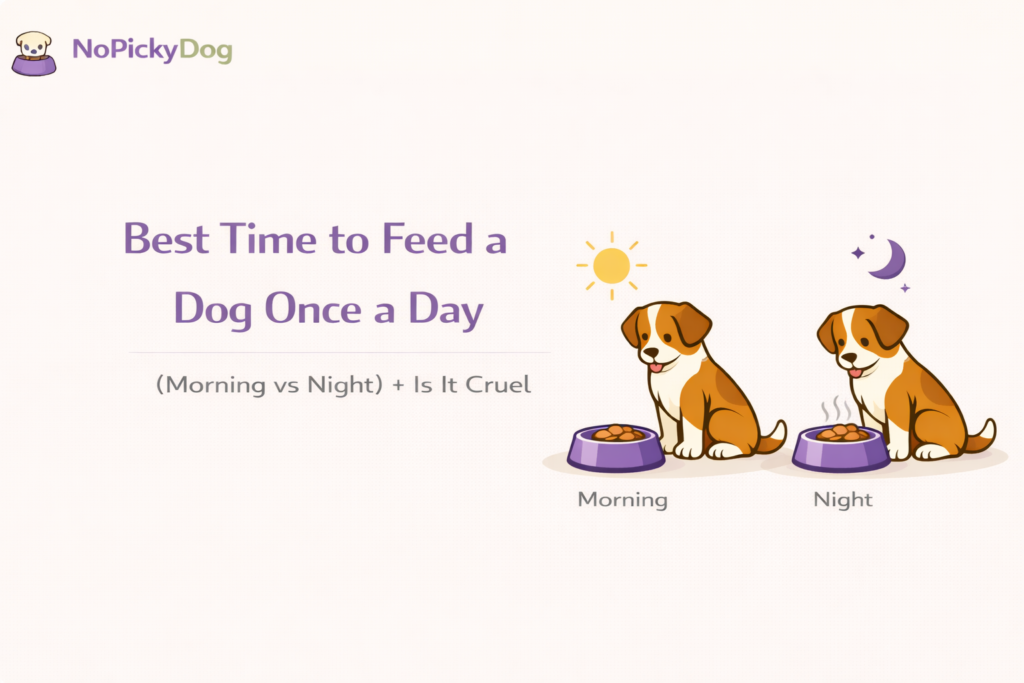
Step-by-step: choosing the best time (morning vs night)
If you’re specifically thinking about feeding once a day at night, use this safety checklist (who it fits, who it doesn’t, and the simplest schedule).
Step 1) Confirm your dog is truly hungry (portions + treats)
Before you change feeding time, make sure you’re not accidentally removing appetite with oversized portions or frequent treats/chews.
Use this portion guide (BCS + calories + 7-day adjustment):
Portion Basics: How Much to Feed a Picky Dog (Without Guessing)
Quick check this week
- No free treats/chews/table scraps between meals for 7 days.
- Measure the meal portion instead of eyeballing.
- Track weight, stool, and energy.
Step 2) Pick a time you can stick to every day
Consistency beats the “perfect” hour.
Default option (works for many adult dogs):
- Evening meal (e.g., 5–7pm)
Consider feeding earlier if:
- Your dog seems nauseous after a long empty stomach.
- They vomit yellow bile in the morning (talk to your vet if this is frequent/worsening).
Step 3) If your dog skips breakfast but eats dinner, don’t fight mornings
Many dogs reliably eat later. This can be routine, treat/portion math, or mild morning nausea. In that case, feeding later is often more realistic than forcing breakfast.
Start here:
Dog Won’t Eat Breakfast but Eats Dinner? Is It Normal + What to Do
Step 4) Run a clean 7-day timing trial (without “upgrades”)
If you’re unsure whether morning or night works better, don’t guess—test it.
For 7 days:
- Feed once daily at the chosen time.
- Put food down for 10–15 minutes, then pick it up calmly.
- No toppers, no switching foods “in the moment,” no hand-feeding.
- Keep treats controlled so they don’t replace the meal.
- Track: eating %, water, stool, energy, vomiting.
If eating becomes more consistent, you’ve likely found a workable routine (rather than a food problem).
Helpful reference for meal structure: AAHA’s feeding guide includes practical meal management tips (including removing uneaten food after a short window):
Introduction to Feeding Normal Dogs AAHA
Is it cruel to feed a dog once a day?
Not necessarily. Many healthy adult dogs do fine on one meal a day, especially if:
- They maintain a healthy weight and normal stool
- Energy is normal
- Appetite pattern is stable (not a sudden change)
But once-daily feeding is often not ideal for:
- Puppies
- Underweight dogs or dogs struggling to maintain weight
- Dogs with certain medical conditions (ask your vet if you’re unsure)
For the general principle that nutrition plans should be individualized (not one-size-fits-all), see WSAVA’s global nutrition guidance:
Global Nutrition Guide WSAVA
Vet red flags (when to call today)
Don’t “train through” these. Call a vet if you see:
- Refusal to eat for 24 hours (especially if sudden)
- Repeated vomiting/diarrhea, blood in stool
- Belly pain, bloating, retching, drooling/swallowing repeatedly
- Severe lethargy/weakness, dehydration, refusal to drink
- Rapid weight loss
If your dog isn’t eating but otherwise looks normal, use this decision guide:
Dog Not Eating But Acting Normal? 11 Common Causes + What to Do
If you’re worried about safe limits:
How Long Can a Dog Go Without Eating? Safe Limits + When to Worry
Veterinary overview of decreased appetite (helpful context):
Anorexia in Dogs VCA
Next steps (pick your path)
- If your dog only eats once a day (often at night):
My Dog Only Eats Once a Day (Often at Night): Is It Normal + What to Do - If portions/treat calories might be the real cause:
Portion Basics: How Much to Feed a Picky Dog (Without Guessing) - If breakfast is refused but dinner is eaten:
Dog Won’t Eat Breakfast but Eats Dinner? Is It Normal + What to Do - Return to the hub (picky eating reset + related fixes):
Fix Picky Eating Fast - Wondering if feeding only once a day is cruel?
Learn why it’s not always cruel and when it could be a concern: Should Dogs Only Eat Once a Day? Is It Cruel?
Short medical disclaimer: This content is for informational purposes only and does not replace professional veterinary advice.