Want the numbers in 30 seconds? Use the Treat Budget Calculator (10% Rule).
If you’ve seen the “AAHA 10% rule” for dog treats, you’re not alone. It’s one of the simplest ways to prevent treats (and table scraps) from quietly replacing balanced meals—especially in picky eaters.
This guide shows you how to calculate a realistic daily treat budget in minutes.
Quick answer
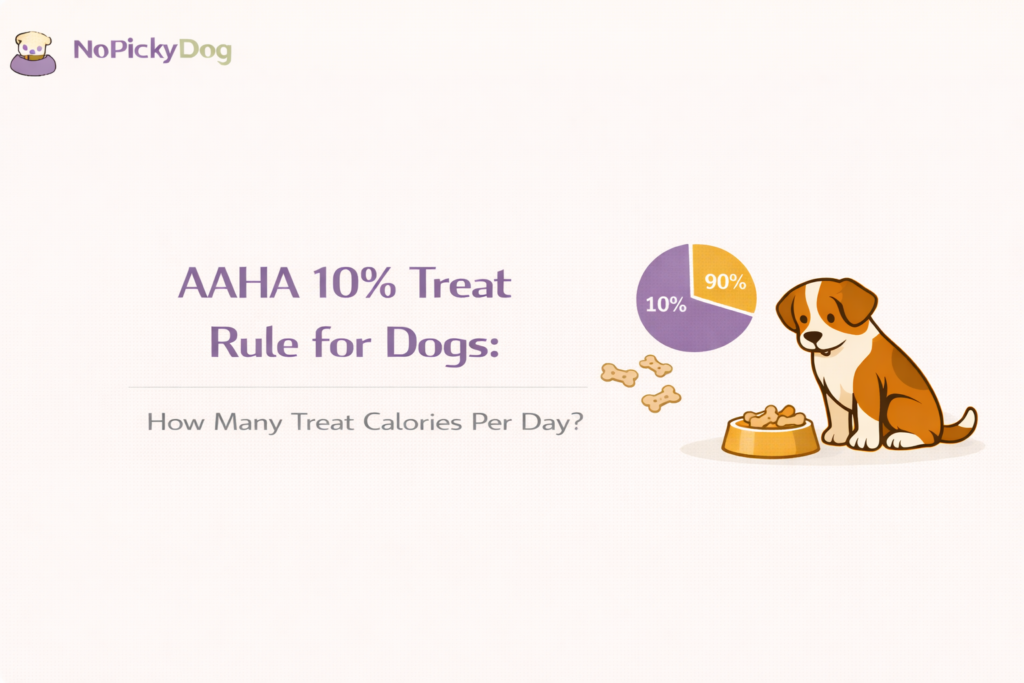
AAHA’s simple rule is this: treats should make up 10% or less of your dog’s daily calories (with 90%+ coming from a complete and balanced diet). This helps prevent treats from quietly replacing meals—one of the fastest ways picky eating gets “trained in.”
Use it today (2-minute math):
- Find your dog’s daily calories (from your food label, feeding plan, or vet target).
- Multiply by 0.10 to get your daily treat calorie budget.
- Divide by calories per treat to estimate how many pieces you can use.
Example: If your dog eats 600 kcal/day, treats should be 60 kcal/day or less.
If you want the numbers instantly, use the calculator here: Treat Budget Calculator (10% Rule).
When to be more conservative: If your dog is gaining weight easily, is inactive, or you’re using lots of training rewards, aim closer to 5% and use smaller pieces.
Call your vet if appetite drops suddenly, your dog is vomiting/has diarrhea, seems painful, or is losing weight—treat math won’t solve a medical problem.
Take the 30-second path
Not sure what to do today? Take the 30-second path.
Steps
Step 1) Find your dog’s daily calorie target (the “daily calories” number)
Use one of these (best to simplest):
- Your food label: many diets list calories (kcal) per cup/can and a daily feeding range.
- Your vet’s target: ideal if your dog is overweight, underweight, or has a medical condition.
- A quick estimate (good enough for treat budgeting): start with your current daily food amount and its kcal/cup (or kcal/can).
Why this matters: the 10% rule is a percentage of total daily calories, not “10% of the bowl.”
Step 2) Calculate the 10% treat budget
Treat calories per day = daily calories × 0.10
Examples:
- If your dog eats 600 kcal/day → treats ≤ 60 kcal/day
- If your dog eats 900 kcal/day → treats ≤ 90 kcal/day
If you want to be extra conservative for a dog who gains weight easily, aim closer to 5% instead of 10%.
Step 3) Convert treat calories into “how many treats”
Treat labels vary wildly. Do this:
- Check the package for kcal per treat (or kcal per piece).
- If calories aren’t listed, treat companies can usually provide them.
Then:
Number of treats = treat budget ÷ calories per treat
Example:
- Treat budget: 60 kcal/day
- Treat is 6 kcal each
- 60 ÷ 6 = 10 small treats per day
Step 4) If your dog is picky, protect meals first
The 10% rule works best when you also do these two things:
- Give treats after meals, not before (so treats don’t replace hunger).
- Use tiny training pieces (split treats, or use kibble as rewards).
If your dog won’t eat kibble but happily eats treats, treat budgeting is often the fastest “first fix.”
Step 5) Use trustworthy references (optional, for deeper reading)
These pages explain why keeping treats under ~10% helps prevent excess calories and nutrient imbalance:
- AAHA — “5 Ways to Know How Much to Feed Your Pet” (mentions treats ≤10% of daily calories; good for parent-friendly guidance)
- Merck Veterinary Manual — Feeding Practices in Small Animals (notes total treats should be <10% of caloric intake; more clinical)
- VCA — Treats should make up to 10% of calories (with nuance) (helps explain why 5% can be safer for some pets)
Where the “10% treat rule” comes from (trusted references)
- AAHA guidance on feeding amounts — Useful because it explicitly recommends keeping treats within about 10% of daily calories so treats don’t replace a balanced diet.
- Merck Veterinary Manual: Feeding practices in small animals — Useful as a more clinical reference that also notes treats should stay under a small share of total caloric intake (commonly <10%).
- VCA: Treat calories “true or false” explainer — Useful for pet parents because it explains the idea in plain language and adds practical nuance (some dogs may need a more conservative treat budget).
Vet red flags
Treat math is not the main issue—get veterinary guidance if you see any of these:
- Rapid weight loss or weight gain
- Vomiting, diarrhea, or persistent soft stool
- Refusing food for 24+ hours (adult) or 12+ hours (puppy/small dog), especially with lethargy
- Increased thirst/urination, weakness, or sudden behavior change
- History of pancreatitis, diabetes, or chronic GI disease (treat choices and amounts may need tighter limits)
Next steps
Pick the path that matches your situation:
• Do the treat math (fast):
Treat Budget Calculator (10% Rule)
• Treats are replacing dinner:
Treats vs Meals: The 10% Rule (Stop Treats From Replacing Dinner)
• Dog won’t eat kibble but eats treats:
Dog Won’t Eat Kibble but Eats Treats? Fix It (7-Step Plan)
• Not sure what to do today:
Tools for Picky Eaters (30-second path)
Medical disclaimer: This content is for informational purposes only and does not replace professional veterinary advice.
Related guides
Portion Basics: How Much to Feed a Picky Dog (Without Guessing)
How to Fix a Picky Eater Dog Fast: A 7-Day Plan That Works
Stop Hand-Feeding a Picky Dog (Without Stress): A Simple 7-Day Reset
Dog Picky With Food All of a Sudden? 10 Real Causes + What to Do Today