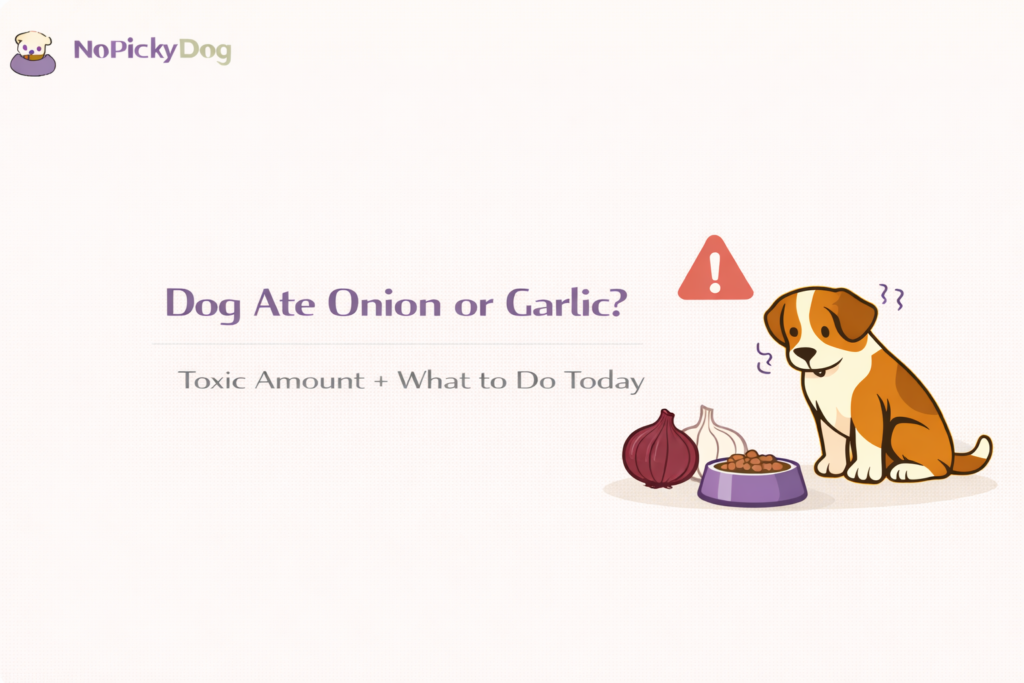
It’s a scary moment. You turn your back for a second, and your dog swipes a piece of onion, a clove of garlic, or a dish cooked with onion powder.
Unlike some foods that just cause an upset stomach, plants in the Allium family (onions, garlic, leeks, chives) can cause lasting damage to your dog’s red blood cells.
Do not wait for symptoms to start. The clock matters. Here is exactly how to assess the danger and what to do right now.
Quick Answer
Yes, onions and garlic are toxic to dogs in all forms (raw, cooked, powdered, or dehydrated).
They contain N-propyl disulfide, which destroys red blood cells and causes anemia. Garlic is about 5x more potent than onions.
- The Toxic Threshold: Generally, 0.5% of the dog’s body weight in onions is toxic. For garlic, it takes much less (about 15-30 grams per kg).
- Powder is Dangerous: Onion and garlic powder are highly concentrated. A small spill can be deadly for a small dog.
Immediate Action: If your dog ate a significant amount within the last 2 hours, go to the vet immediately.
Step 1: Calculate the “Danger Zone”
Before you panic, let’s look at the math. The toxicity is dose-dependent.
For Onions (Raw or Cooked)
A general rule of thumb from veterinary toxicology is that 15 to 30 grams of onion per kilogram of body weight is enough to cause clinically significant hematologic changes.
- 10 lb (4.5 kg) Dog: ~60–70 grams of onion (about 1/4 to 1/2 of a medium onion) is dangerous.
- 50 lb (22 kg) Dog: ~300+ grams of onion (about 1.5 to 2 medium onions) is dangerous.
For Garlic (More Potent)
Garlic is more concentrated. It takes significantly less to cause issues, but “one tiny dropped piece” is usually not fatal for a medium-sized dog. However, for a Chihuahua, even a small clove can be risky.
Warning: Onion/Garlic Powder is the real silent killer. It is dehydrated and concentrated. If your dog licked up a pile of spilled powder, treat this as a medical emergency regardless of dog size.
Step 2: Check for Hidden Sources
It’s not just the raw vegetable. Check if the food they ate contained:
- Onion powder (common in chips, soups, and baby food).
- Garlic salt.
- Chives or Leeks.
- Dishes cooked with a mirepoix base (onions/carrots/celery).
If the food was mostly meat but cooked with onions, the juices might still contain the toxins.
Step 3: Watch for Red Flags (The 1-5 Day Lag)
Unlike chocolate poisoning, symptoms of onion toxicity often don’t show up immediately. It can take several days for the red blood cells to break down (hemolysis).
Vet Red Flags:
- Pale gums (white or greyish, not pink).
- Red or brown urine (a sign of blood cell breakdown).
- Lethargy or weakness (fainting).
- Rapid breathing (panting while resting).
- Vomiting or diarrhea (immediate symptom).
External Resource: For a detailed list of clinical signs, refer to the Merck Veterinary Manual on Allium Toxicosis.
Next steps
Pick the path that matches your situation:
- If your dog ate a large amount (or powder) < 2 hours ago: Go to the Emergency Vet immediately.
- If you are unsure if the food is safe to feed: Check our Food Safety Tool
- If your dog is picky after recovering: Start the 30-Second Path Picker
Medical disclaimer: This content is for informational purposes only and does not replace professional veterinary advice.