If your dog is acting picky, there is usually a reason. Sometimes it is pain or nausea. But very often the hidden reason is simple: your dog is not truly hungry at mealtimes. Portions creep up. Treats add up. And “just a little topper” becomes a second meal.
This guide gives you a clear, repeatable way to set portions without guessing: check body condition, estimate daily calories, measure consistently, control treat calories, and adjust calmly over 7 days.
When to worry (vet red flags)
Contact a veterinarian promptly if your dog’s appetite change comes with any of the following:
Vomiting or diarrhea, especially persistent or severe
Blood in vomit or stool
Lethargy, weakness, dehydration, collapse
Obvious pain, drooling, pawing at the mouth, or reluctance to chew
Sudden appetite loss in a normally food-motivated dog
Rapid weight loss or refusing water
Puppy, senior dog, or dog with chronic conditions (for example diabetes)
Authoritative reference:
Why Won’t My Dog Eat? (American Kennel Club)
If none of the red flags apply and your dog seems normal otherwise, keep reading.
Quick answer (the portion reset in 60 seconds)
- Check Body Condition Score (BCS) first.
- Use a calorie calculator to get a starting daily calorie target.
- Convert calories to a real portion using the food’s kcal/cup (or kcal/kg).
- Keep treats and extras to 10% or less of daily calories.
- Soft stool during a transition is often a “too much, too fast” problem—start here: Soft Stool During a Dog Food Transition: What to Do + When to Worry
- Adjust by about 10% after 7 days based on weight trend + BCS.
Step 1: Start with body condition (BCS), not the bowl
Portions are not one-size-fits-all. Two dogs at the same weight can need different calories depending on body fat and muscle.
How to do a 30-second BCS check:
Feel the ribs: you should feel ribs with a light fat covering (not sharp, not buried).
Look from above: there should be a waist behind the ribs.
Look from the side: there should be an abdominal tuck.
Use a real chart while you check:
Body Condition Score (Dog PDF, WSAVA)
What BCS means for picky eating:
If your dog is overweight, “picky” is often “not hungry.”
If your dog is underweight or losing weight, treat appetite change as higher priority and discuss with your vet.
Step 2: Get a starting calorie target (don’t overthink it)
The simplest option is to use a veterinary-style calculator:
Calorie calculator (dogs, Pet Nutrition Alliance)
This gives you a starting number. Real dogs vary. That’s why Step 5 uses a 7-day feedback loop.
Step 3: Convert calories into a real portion (cups lie, grams don’t)
Once you have a daily calorie target, you need your food’s calorie density.
Find “kcal per cup” or “kcal per kg” on your food label.
Then do this:
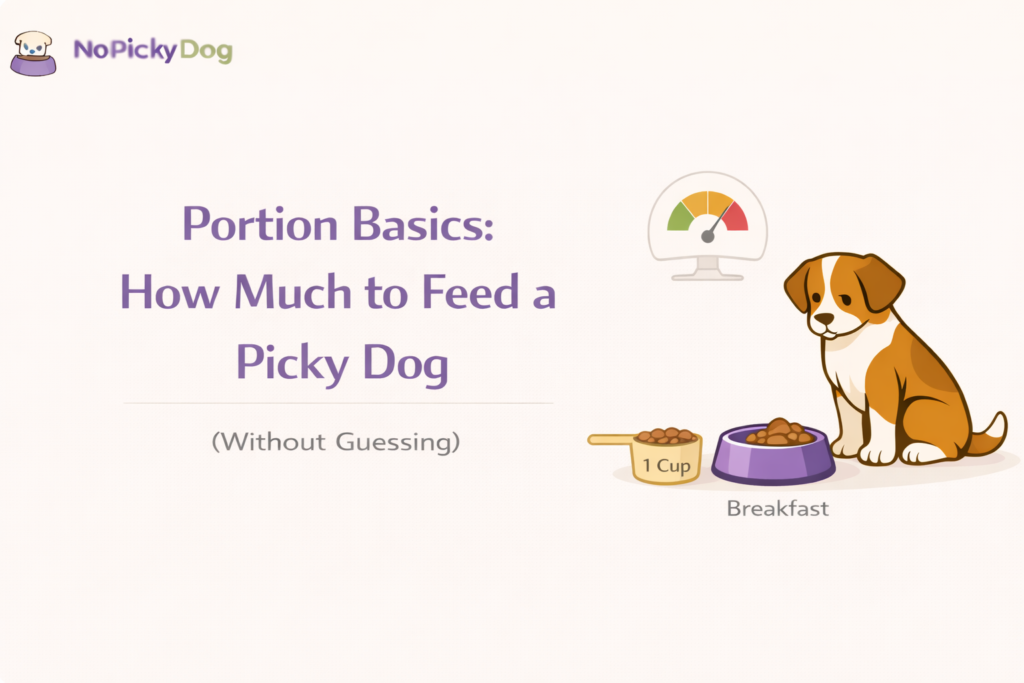
Daily calories needed ÷ kcal per cup = cups per day total
Split into two meals.
Example:
If your food is 400 kcal per cup and your dog needs 800 kcal/day, that’s 2 cups/day total.
Two meals = 1 cup AM + 1 cup PM.
Measure the same way every day:
Best: use a kitchen scale and measure in grams.
If you use cups: use the same scoop and level it the same way. No eyeballing.
Step 4: Treat calories are the #1 portion killer (use the 10% rule)
Even “small” treats can erase appetite. Chews, dental treats, table scraps, and training rewards add up fast.
Simple rule:
Treats and additional food items should not exceed 10% of the daily caloric intake.
Authority reference:
Treat guidelines for dogs (UC Davis PDF)
Practical tip for the reset:
For 7 days, either pause treats entirely or switch to tiny training rewards away from meals. Don’t use treats to rescue missed meals.
Step 5: The 7-day portion adjustment plan (how to know you’re right)
Portion setting is a feedback loop. Do this for one week before changing again.
Day 1–7 rules:
Keep meal times consistent.
Keep portions measured (same grams/cups daily).
Keep treats within the treat budget.
No “upgrades” after refusal (no toppers, no hand-feeding during the reset).
Use the 10–15 minute bowl window if your dog stalls.
What to track (60 seconds/day):
Appetite at meals (eats immediately vs hesitates)
Stool quality
Energy
Vomiting (if any)
How to adjust after 7 days:
If weight is creeping up or BCS looks softer: reduce daily portion by about 10%.
If your dog is getting too thin or losing too fast: increase by about 10%.
If weight and BCS look stable: keep the portion.
Common mistakes that make dogs “picky”
Counting only meals but not treats/chews
Free-feeding (no meal rhythm)
Using different cups/scoops (inconsistent portions)
Changing foods before fixing portions and schedule
Adding toppers after refusal (teaches “skip = upgrades”)
Quick help for common situations
If your dog refuses the measured portion:
Don’t switch foods first. Keep the schedule, use the 10–15 minute bowl window, and stop upgrades for 3–7 days.
If your dog eats only once a day (or mostly at night):
This is often portion + treat + schedule. Remove hidden calories and run the 7-day adjustment plan.
If your dog skips breakfast but eats later:
Late-night snacks, treats, and free-feeding are the first things to fix before changing foods.
Next steps
Pick the path that matches your situation:
- If you’re worried it might be medical:
Dog Not Eating But Acting Normal? 11 Common Causes + What to Do - Use the treat budget rule (stop treats from replacing dinner):
Treats vs Meals: The 10% Rule (Stop Treats From Replacing Dinner) - If your dog only eats once a day (often at night):
My Dog Only Eats Once a Day (Often at Night): Is It Normal + What to Do - If you feed once daily and want the best timing (morning vs night) + “is it cruel?”
Best Time to Feed a Dog Once a Day (Morning vs Night) + Is It Cruel? - If breakfast is skipped but dinner is eaten:
Dog Won’t Eat Breakfast but Eats Dinner? Is It Normal + What to Do - If meals became a daily battle (run the reset):
How to Make a Picky Dog Eat (Fast): A 7-Day Reset Plan
Medical disclaimer: This content is for informational purposes only and does not replace professional veterinary advice.