If your dog skips meals but happily eats treats, you’re not alone. This pattern usually isn’t “stubbornness” — it’s often a treat calorie + routine problem:
- Treats and chews quietly remove appetite for meals
- Dogs learn that refusing dinner leads to “better options”
- Owners panic-switch foods, which reinforces the cycle
This guide gives you a simple, practical fix: the 10% rule + a clean reset you can start today.
If your dog won’t eat kibble but eats treats, start here too:
Dog Won’t Eat Kibble but Eats Treats? Fix It (7-Step Plan)
Quick answer (what to do today)
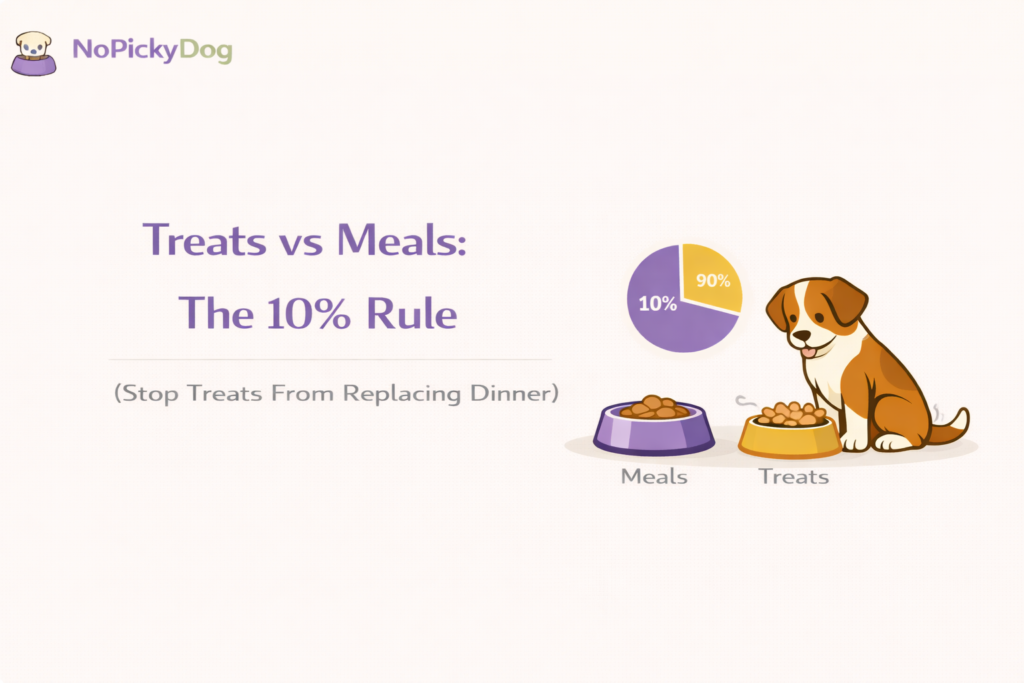
Treats should not replace meals. A practical limit is the 10% rule: keep treats at 10% or less of your dog’s daily calories, and make the main diet (their complete, balanced food) at least 90%.
This is the same pattern behind many “picky eaters”: refusing dinner gets rewarded with better options. Here’s the underlying behavior loop:
Why Dogs Get Picky: The “Upgrade Loop” (How Treats & Toppers Teach Refusal)
Do this today:
- Stop “free treats” between meals for 7 days (training treats are allowed — but count them).
- Measure the meal portion (don’t eyeball).
- Choose a treat budget: Daily calories × 0.10 = max treat calories/day.
- Use tiny rewards away from the bowl. Do not use treats to “convince” your dog to eat dinner.
- If your dog shows vomiting/diarrhea/pain/lethargy or suddenly refuses food, call a vet.
Want the AAHA version (with clear examples)?
Read: AAHA 10% Treat Rule for Dogs: How Many Treat Calories Per Day?
The 10% rule (explained simply)
The 10% rule means:
- 90%+ of calories should come from a complete and balanced diet (their regular food).
- ≤10% of calories should come from treats, chews, table scraps, toppers, and “extras.”
Why it matters:
- Too many treats can cause weight gain
- It can unbalance nutrition if treats replace a meaningful amount of the main diet
- It can create picky-eating behavior (“hold out for upgrades”)
Helpful references:
WSAVA (treat calories ≤10%):Feeding treats to your dog WSAVA
AAHA (treats ≤10% of daily calories):Healthy and Low-Calorie Snacks for Pets AAHA
Step-by-step: set your treat calorie budget (in 2 minutes)
Step 1) Find (or estimate) daily calories
If you already use our portion guide, use its method and calorie targets:Portion Basics: How Much to Feed a Picky Dog (Without Guessing)
If you don’t know your dog’s calories yet, you can still start with the behavior reset below and tighten the numbers later.
Step 2) Calculate the treat budget
Treat budget = Daily calories × 0.10
Examples:
- 500 kcal/day → treats up to 50 kcal/day
- 900 kcal/day → treats up to 90 kcal/day
Step 3) Spend the budget on “micro-treats”
Most people overfeed treats because the pieces are too big.
- Break treats into tiny pieces
- Prefer low-calorie treats
- For training, use “many tiny rewards” instead of “few big rewards”
Better goal (if your dog is picky or gaining weight):
Target 5% treat calories when possible.
(Reference: VCA notes 10% is the maximum, and aiming for 5% is often safer.)
Want simple treat ideas that fit the 10% cap? 2-Ingredient Dog Treats (6 Safe Ideas + Portion Rules)
How treats replace dinner (the common trap)
Here’s the loop:
1) Dog eats treats/chews during the day
2) Dog is not hungry at mealtime (or learns refusal gets upgrades)
3) Owner offers toppers/hand-feeding/new food
4) Dog learns: “Wait it out, something better comes”
If this sounds familiar, don’t change foods first — change the rules around treats and mealtime.
The 7-day reset: keep training rewards without ruining meals
For 7 days:
- Keep two consistent meal times.
- Put food down for 10–15 minutes, then pick it up calmly.
- No upgrades at the bowl: no toppers, no switching foods “in the moment,” no hand-feeding.
- Treats are allowed only if:
- They stay inside your daily treat budget
- They are given away from the food bowl
- They do not replace meals
If picky eating is part of the issue, follow the full reset plan here:How to Make a Picky Dog Eat (Fast): A 7-Day Reset Plan
“My dog won’t eat dinner but eats treats” — what to do tonight
Try this:
1) Skip all treats for the rest of the evening.
2) Offer the normal meal for 10–15 minutes, then pick it up.
3) Next meal, repeat without upgrades.
4) Start measuring portions and treat calories tomorrow.
If your dog consistently refuses meals but still begs for treats, use this focused plan:Dog Won’t Eat Kibble but Eats Treats? Fix It (7-Step Plan)
Vet red flags (don’t treat this as “behavior”)
Call a vet if appetite change is sudden and you see:
- Repeated vomiting/diarrhea, blood in stool
- Pain signs, bloating, repeated retching
- Severe lethargy/weakness, dehydration, refusal to drink
- Rapid weight loss
- Refusal to eat for 24 hours
Next steps
Pick the path that matches your situation:
- Fix treat/portion math (most common):
Portion Basics: How Much to Feed a Picky Dog (Without Guessing) - If treats are winning over kibble (reset the pattern):
Dog Won’t Eat Kibble but Eats Treats? Fix It (7-Step Plan) - If you use high-calorie add-ons (like peanut butter) and want a safety checklist:
Can Dogs Eat Peanut Butter? Safe Amount + When It’s Not Safe - Run the full picky-eating reset (7 days, no “upgrades”):
How to Make a Picky Dog Eat (Fast): A 7-Day Reset Plan - Use the AAHA treat-calorie rule (quick math + examples):
AAHA 10% Treat Rule for Dogs: How Many Treat Calories Per Day? - Return to the hub:
Fix Picky Eating Fast
Medical disclaimer: This content is for informational purposes only and does not replace professional veterinary advice.