Disclosure: Some links on this page are affiliate links. If you buy through them, we may earn a commission at no extra cost to you. We only recommend products we believe may help picky dogs. As an Amazon Associate, NoPickyDog earns from qualifying purchases.
Quick answer
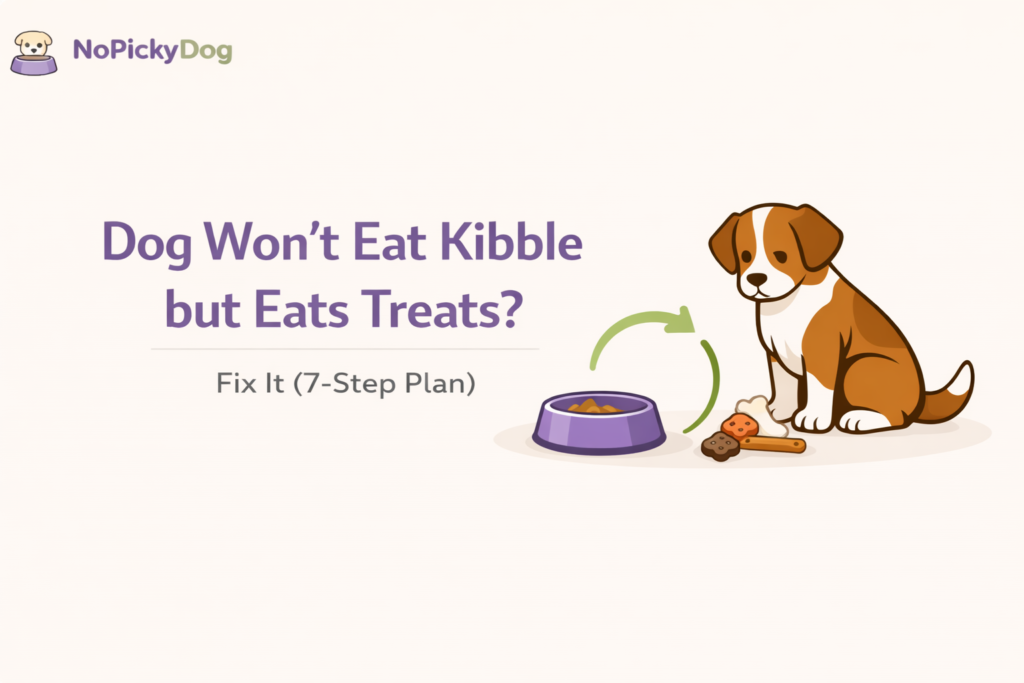
If your dog won’t eat kibble but happily takes treats, it usually means one of three things:
- A learned pattern: treats arrive when the dog refuses meals.
- A routine problem: grazing, inconsistent timing, or too many extras remove hunger.
- A comfort issue: the dog feels better eating small “special bites” than finishing a full meal (stress, nausea, dental discomfort, or rapid eating).
The fix is not endless food switching. The fix is a clear reset: scheduled meals, controlled treats, and calm consistency for 7 days.
If you want a simple, AAHA-based way to set a daily treat limit, use this:
AAHA 10% Treat Rule for Dogs: How Many Treat Calories Per Day?
If you want the “why” behind this pattern (and why food switching often backfires), read this first:
Why Dogs Get Picky: The “Upgrade Loop” (How Treats & Toppers Teach Refusal)
Not sure which pattern fits your dog (learned vs routine vs comfort)? Start here: Dog Picky Eater? Choose the Right Fix (3 Types + What to Do Today)
If you want the full foundation first, start here:
How to Fix a Picky Eater Dog Fast: A 7-Day Plan That Works
And if your dog only eats when hand-fed, read this next:
Stop Hand-Feeding a Picky Dog (Without Stress): A Simple 7-Day Reset
First: rule out real health issues (don’t skip)
Call a vet quickly if your dog has any of these:
- Vomiting or diarrhea, especially more than 24 hours
- Bloody stool
- Lethargy, weakness, dehydration
- Sudden appetite loss in a normally food-motivated dog
- Weight loss
- Pain signs (drooling, pawing at mouth, yelping, avoiding chewing)
- Very young puppy, senior dog, or known chronic illness
If none apply, proceed with the reset plan below.
Why this happens (in plain English)
A dog that refuses kibble but takes treats is rarely “manipulative.” Dogs repeat what works.
If your dog learns that:
- refusing kibble → you offer a tastier option
- refusing kibble → you hand-feed
- refusing kibble → treats appear “to make sure they eat something”
then refusing kibble becomes the fastest way to upgrade the meal.
This is one of the most common picky-eating loops. If you want a deeper overview of causes (stress, routine, reinforcement), read:
https://nopickydog.com/why-dogs-get-picky/
The 7-step plan (do this for 7 days)
Step 1) Pick two meal times and stop grazing
Choose two times you can keep daily (example: 8am and 6pm).
Put food down for 10–15 minutes. Then pick it up, calmly.
No food left out “just in case.” Grazing destroys appetite and makes picky eating worse.
Note: If you are feeding Human Food (chicken, cheese, table scraps) instead of dog treats, the addiction is harder to break. Read the specific guide for Human Food Refusal here
Step 2) Treats become “earned,” not “rescue calories”
For the reset week:
- No random treats between meals.
- If you train, keep treats tiny and count them as part of daily calories.
- Do not use treats as a response to meal refusal.
This is the single biggest lever. Your dog already showed they can eat. You’re changing the rules around what gets rewarded.
Step 3) Stop the “treat test”
Many owners do this without noticing:
- dog refuses kibble
- owner offers a treat “to see if they’re actually hungry”
- dog eats treat
- owner concludes “they’re picky”
In your dog’s brain, that’s not a test. That’s training:
refuse meal → receive premium option.
For 7 days, do not run the treat test.
Step 4) Make kibble feel safe (reduce pressure, not flavor)
Some dogs refuse meals because the whole mealtime feels tense:
hovering, coaxing, pleading, bargaining.
Try this:
- Put the bowl down
- Step back
- Look away
- Do not talk
- Give your dog space to choose
If your dog eats when you leave the room, it’s often pressure, not taste.
Step 5) Fix the “too full” problem
If your dog is getting:
- lots of chews
- big dental treats
- frequent training treats
- table scraps
…they may simply not be hungry at mealtime.
During the reset:
- Remove extra calories.
- Keep meals consistent.
- If you must use rewards, use micro-treats.
A dog can’t “learn to eat” if they’re not hungry.
Step 6) Use a consistent “meal format” (no negotiating)
For the full 7 days, keep these constant:
- same bowl
- same location
- same meal times
- same duration (10–15 minutes)
- same food (unless a vet tells you otherwise)
Food switching during a reset teaches your dog that waiting produces a different outcome.
Step 7) Only after 7 days, adjust the plan (not daily)
At the end of 7 days, assess:
If your dog eats both meals most days:
You’re done. Keep the schedule for 2–3 weeks to lock in the habit.
If your dog eats one meal but skips the other:
Keep the schedule and reduce extras further. Most dogs stabilize with time.
If your dog regularly skips multiple meals:
Consider a vet check and review stress triggers, dental comfort, and GI tolerance.
What to do if your dog skips a meal
Healthy adult dogs can skip a meal during a reset. The danger is not the skipped meal. The danger is teaching the dog that skipping produces upgrades.
Use this decision rule:
- Skips 1 meal: normal. Continue the plan.
- Skips 2 meals: continue, but tighten rules (no extras).
- Skips 3 meals or shows red flags: call a vet.
Common mistakes (that keep the loop alive)
- Adding toppers “just this time”
- Hand-feeding after refusal
- Switching kibble repeatedly
- Offering treats to “make sure they eat”
- Leaving food down all day
- Talking, hovering, bargaining at the bowl
If you remember only one thing:
Refusal must not produce a better outcome.
If your dog only eats when you hand-feed
That’s a specific sub-problem and you need a specific reset. Use this guide:
Stop Hand-Feeding a Picky Dog (Without Stress): A Simple 7-Day Reset
If you’re mixing in fresh food or human food
Fresh food can be great, but it must be safe and consistent, not a bribe. Use this safety hub before adding anything new:
Dog Food & Safety Guides
Recommended tools (optional, but helpful)
Affiliate note: If you buy through these links, we may earn a commission at no extra cost to you.
1) Measuring scoop/cup (portion consistency)
Inconsistent portions create inconsistent hunger. A scoop is the simplest way to standardize meals (a kitchen scale is even better, but this is the easiest start).
- Best overall: [Measuring scoop/cup (Amazon)]
- Budget pick: [Budget measuring scoop/cup (Amazon)]
How to use: measure the same amount at both meals for 7 days. No “top-ups.”
2) Puzzle feeder (reduce boredom + attention loops)
If your dog “nibbles and walks away,” the missing piece can be engagement. A puzzle feeder turns a meal into a calm task without adding toppers.
- Best overall: [Puzzle feeder (Amazon)]
- Budget pick: [Budget puzzle feeder (Amazon)]
How to use: use it for one meal per day during the reset week.
FAQ
Is my dog being stubborn?
Usually no. Dogs repeat patterns that worked before. If refusal gets treats, refusal will continue.
Should I change kibble if my dog won’t eat it?
Not during the 7-day reset. Fix the routine first. If the routine is stable and appetite is still poor, then evaluate food fit (and consider a vet check).
My dog eats treats. Doesn’t that prove they’re hungry?
It proves they will eat something valuable. It does not prove they’re hungry enough for a full meal, and it often proves the reward structure is upside down.
Can I use toppers during the reset?
Avoid toppers for 7 days. After the reset, planned toppers can be fine, but they must not be used as a response to refusal.
Next steps
Pick the path that matches your situation:
- Use the treat budget rule (stop treats from replacing dinner):
Treats vs Meals: The 10% Rule (Stop Treats From Replacing Dinner) - Fix portions/treat calories (most common “not hungry” cause):
Portion Basics: How Much to Feed a Picky Dog (Without Guessing) - Run the full picky-eating reset (7 days):
How to Make a Picky Dog Eat (Fast): A 7-Day Reset Plan - If hand-feeding is part of the pattern:
Stop Hand-Feeding a Picky Dog (Without Stress): A Simple 7-Day Reset - If mornings are consistently the worst:
Dog Not Eating in the Morning? 9 Common Causes + What to Do - If you’re worried it might be medical:
Dog Not Eating But Acting Normal? 11 Common Causes + What to Do - Peanut Butter for Dogs: Safe Amount + Label Warnings
Can Dogs Eat Peanut Butter? Safe Amount + When It’s Not Safe - Food & safety (before adding new extras):
Food & Safety Guides
Medical disclaimer: This content is for informational purposes only and does not replace professional veterinary advice.