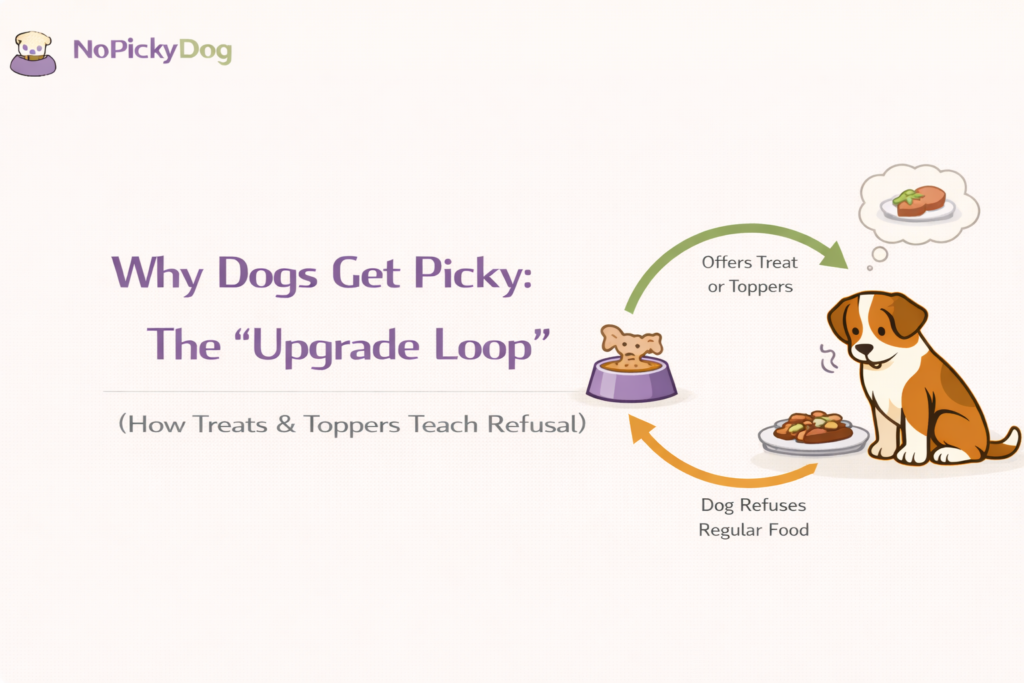
Most “picky dogs” aren’t randomly picky. They’re learning a simple pattern:
Refuse the meal → better options appear.
This is the upgrade loop. It can start with love (hand-feeding), worry (“he didn’t eat”), or small extras (toppers, treats, broth). But over time, the dog learns that waiting wins.
Quick answer
If your dog will skip kibble but take treats, toppers, or hand-feeding, the most common reason is the upgrade loop:
- The dog learns refusal is rewarded (better food appears).
- Routine becomes inconsistent (timing shifts, grazing happens).
- Appetite gets quietly “filled” by treats/chews or oversized portions.
The fix is usually not endless food switching. The fix is a clear reset: predictable meals, no upgrades at the bowl, and controlled calories for 7 days.
Steps
Step 1: Spot which upgrade pattern you’re in (30 seconds)
Pick the closest match:
Pattern A — “Refuse → upgrades appear”
Signs:
- Your dog sniffs, walks away, then suddenly eats when you add something.
- They eat better after you open a new bag/can.
- They hold out until you hand-feed or offer treats.
What it teaches:
Refusal gets a better option.
Pattern B — “Timing/routine is doing the training”
Signs:
- Meals happen at different times each day.
- Food stays down all day (grazing).
- Your dog eats late at night or only when you’re home.
What it teaches:
Meals aren’t predictable, so waiting is safe.
Pattern C — “Not actually hungry (calories add up)”
Signs:
- Your dog loves treats/chews but “doesn’t touch dinner.”
- They’re getting multiple chews, training treats, peanut butter, toppers, or table scraps.
- Portions are guessed, not measured.
What it creates:
Dinner refusal because appetite is already met elsewhere.
Step 2: Break the loop with 3 rules (the reset that works)
Use these rules for 7 days:
Rule 1 — Fixed meal times, no grazing
- Choose 2 meal times (or 1 if your dog truly does better once daily).
- No free-feeding in between.
Rule 2 — The 10–15 minute rule
- Put food down.
- After 10–15 minutes, pick it up calmly.
- No “second offers” 30 minutes later.
Rule 3 — No upgrades at the bowl
For the 7-day reset:
- No toppers.
- No “better options.”
- No hand-feeding.
You’re removing the accidental reward.
Step 3: Control the hidden calorie problem (the #1 silent cause)
Even a “small” amount of extras can replace a meal.
Do this today:
- Measure the meal portion.
- Track treats/chews for 24 hours.
- If treats are needed for training, use part of the daily kibble as treats (same calories, different delivery).
Step 4: If you must use toppers, use them without teaching refusal
After the reset (not during it), if you add a topper:
- Mix it in before serving (no “upgrade after refusal”).
- Keep it consistent (same topper, same amount).
- If the dog refuses, do not add more—pick up the bowl and try next scheduled meal.
Step 5: When switching foods helps (and when it backfires)
Switching can help some dogs, but switching too fast often causes stomach upset and more refusal.
If your dog gets soft stool during a transition, stabilize first:
Soft Stool During a Dog Food Transition: What to Do + When to Worry
Vet red flags
If appetite change is sudden AND you notice vomiting, diarrhea, repeated gagging, abdominal pain, bloating, severe lethargy, dehydration, blood in stool, rapid weight loss, or your dog won’t eat for 24 hours, don’t “train through it.”
Why these red flags matter (trusted references)
- Merck Veterinary Manual (dog-owner digestive disorders overview): appetite loss is commonly listed alongside vomiting/diarrhea/abdominal pain and other illness signs—use it as a “don’t ignore” signal.
- AAHA (10 pet health signs you should never ignore): highlights warning signs owners should treat as medical, not behavioral—useful for deciding when to call a vet.
Next steps
Pick the path that matches your situation:
- If treats are replacing meals (most common):
Dog Won’t Eat Kibble but Eats Treats? Fix It (7-Step Plan) - If you want to reset picky eating without toppers:
How to Fix a Picky Eater Dog Fast: A 7-Day Plan That Works - If you’re not sure portions/treat calories are the real issue:
Portion Basics: How Much to Feed a Picky Dog (Without Guessing) - If you want more “can dogs eat this?” answers:
Dog Food & Safety Guides
Medical disclaimer: This content is for informational purposes only and does not replace professional veterinary advice.